
Project Helix Xbox Reactions: IGN Asks 'What Is an Xbox?' Ahead of GDC 2026
Project Helix conversation surged on X on March 7 as IGN, pricing skeptics, and Valve comparison posts pushed debate around whether Microsoft's next Xbox is still a traditional console.
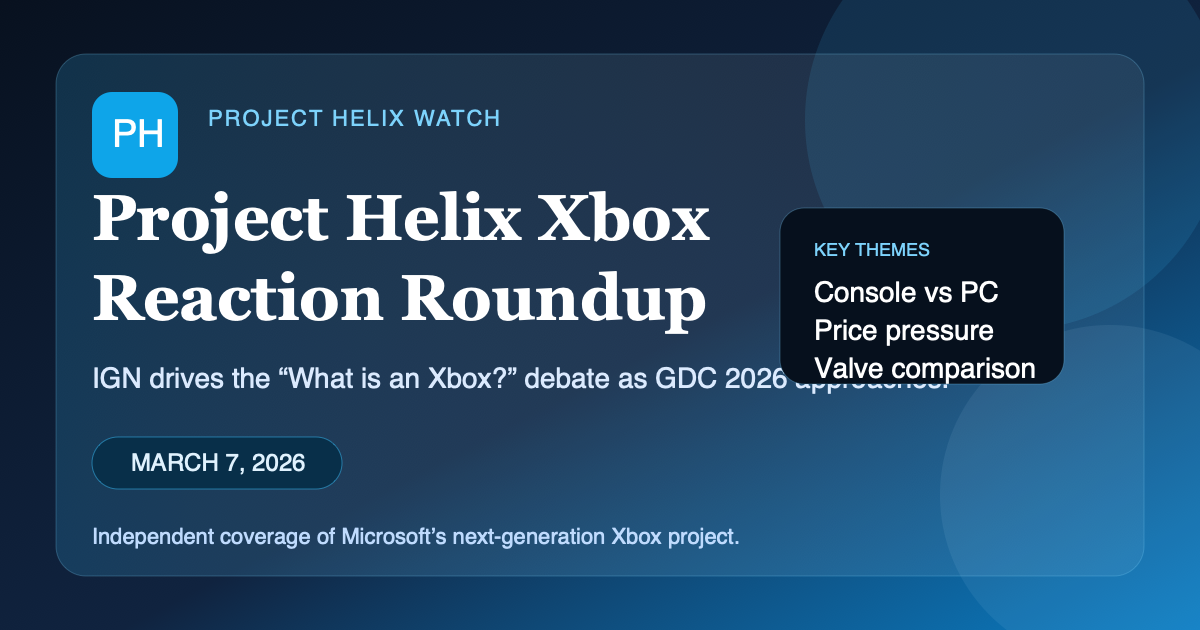
Project Helix did not receive any new official announcement overnight, but conversation on X accelerated again in the early hours of March 7, 2026. Based on posts circulating between roughly 00:00 and 00:45 UTC (08:00 to 08:45 HKT), the story shifted away from basic “is it real?” reporting and toward a broader argument about what kind of machine Microsoft is actually building.
The central theme was not a new leak. It was a framing change: if Project Helix plays both Xbox and PC games natively, how much of the traditional console definition still applies?
What Changed on March 7
The most visible catalyst was a new IGN social post linking to its feature on Project Helix and the future of the Xbox identity. That article pushed the debate beyond specs and launch timing into platform definition, ecosystem control, and whether Microsoft’s next hardware could blur the console/PC boundary more aggressively than any prior Xbox.
At the same time, smaller X accounts pushed two related narratives:
- Price skepticism: users speculated that a hybrid Xbox/PC design could force pricing well above the traditional console range.
- Identity skepticism: critics argued that a Windows-adjacent, storefront-flexible machine may behave more like a managed living-room PC than a classic closed console.
- Competitive pressure talk: replies around Valve’s Steam Machine timing and hypothetical PS6 positioning framed Helix as a device that could force other platform holders to respond even before Microsoft reveals full specs.
None of those posts independently confirm new product details. What they show is where public attention is concentrating ahead of GDC 2026.
The Five Most Notable Posts
1. IGN sets the tone
IGN’s March 7 X post was the clear engagement leader in this batch, pointing readers to a feature that asks the biggest strategic question raised by Helix so far: when does an Xbox stop being a console in the historical sense and become something closer to a curated PC platform?
Why it matters:
- It came from a major games media outlet rather than a rumor account
- It reframed Helix as a category question, not just a hardware rumor
- It amplified the already-growing discussion triggered by Microsoft’s March 5 confirmation that the system will play both Xbox and PC games
As captured at the time of this roundup, the post led the wave with roughly 268 likes, 30 reposts, 35 replies, and more than 22,000 views.
2. Sarcastic pricing and AI backlash posts gain traction
A smaller but telling cluster of posts used sarcasm to criticize what some players fear Helix could become: an expensive AI-heavy box with a compromised user experience. One representative example mocked the idea of a “$700 console” wrapped in ad-heavy UI and AI marketing language.
This kind of post does not add factual reporting. It does, however, reveal a real reputational risk for Microsoft: if Helix is perceived as too PC-like, too expensive, or too dependent on Copilot-style branding, discussion can turn hostile very quickly.
3. Valve and Steam Machine discourse enters the conversation
A separate line of replies tied Helix to renewed talk around Valve hardware, especially after discussion around Steam Machine timing. The direct claim that “Helix has the industry worried” is not itself evidence of platform-holder panic, but it is notable that Helix is now being used as a comparison point in broader hardware conversations rather than only Xbox-specific reporting.
That is a sign of narrative expansion. Project Helix is starting to be discussed as a market-shaping product concept, not just Microsoft’s next box.
4. “Xbox is leaving the console market” becomes a live argument
Several smaller commentary accounts leaned into the more extreme interpretation: that Helix means Xbox is effectively exiting the traditional console business. That conclusion goes further than the confirmed facts support, but it is becoming a recognizable discourse lane on X.
The reason is straightforward. If Microsoft keeps backward compatibility, preserves Xbox identity, and still opens the platform to broader PC software behavior, Helix may look simultaneously more capable and less conventionally “console-like.” That tension is exactly what is driving the discussion.
5. Low-engagement article shares still help spread the framing
Even low-engagement posts linking to third-party writeups matter in this phase because they reinforce the same three questions:
- What will Helix cost?
- How much PC openness will Microsoft actually allow?
- Will Sony and Valve need to adjust because of it?
The repetition matters more than the size of any single account. It suggests the narrative is stabilizing around those issues before GDC.
Editorial Take: This Is A Reaction Story, Not A New Confirmation
From an editorial standpoint, this March 7 wave is worth covering because it shows how quickly public interpretation has moved from “Project Helix exists” to “Project Helix may redefine the console category.”
But it is important not to overstate the significance:
- There was no new official Microsoft statement in this batch
- There was no new credible leak on specs, price, or release timing
- The most valuable signal here is media framing and community reaction, not fresh hardware evidence
That means this update should sit alongside our existing reporting, not replace it. The confirmed facts remain the same: Microsoft has acknowledged Project Helix by name, confirmed Xbox-plus-PC game support, and pointed to GDC 2026 (March 9 to March 13) for further discussion.
What To Watch Next
If this social momentum continues into GDC, the first concrete Microsoft clarifications that could change the story are:
- Whether Helix runs on a Windows-based architecture in practice
- Whether non-Microsoft PC storefronts are part of the real launch plan
- Whether Microsoft positions the device explicitly as a console, a hybrid platform, or something in between
- Whether pricing language signals a premium tier beyond the historical Xbox norm
Until then, the March 7 X surge is best understood as a temperature check: the audience is no longer only asking whether Helix is real. It is asking whether Microsoft’s next Xbox changes the meaning of the word “console.”
Sources
- IGN on X: https://x.com/IGN/status/2030071266518904992
- IGN feature: https://www.ign.com/articles/project-helix-asks-what-is-an-xbox
- james banger on X: https://x.com/brittlehoellow/status/2030072412075606182
- Geoff Keighley related reply thread: https://x.com/badguy974/status/2030080852755980393
- Geoff Keighley on X: https://x.com/geoffkeighley/status/2030077743497695540
- Tripster on X: https://x.com/TRIPSTER0/status/2030072790120874424
- TechRook on X: https://x.com/tech_rook/status/2030078645079773444
- TechRook article: https://www.techrook.com/2026/03/microsoft-unveils-project-helix-xbox.html
Related: